
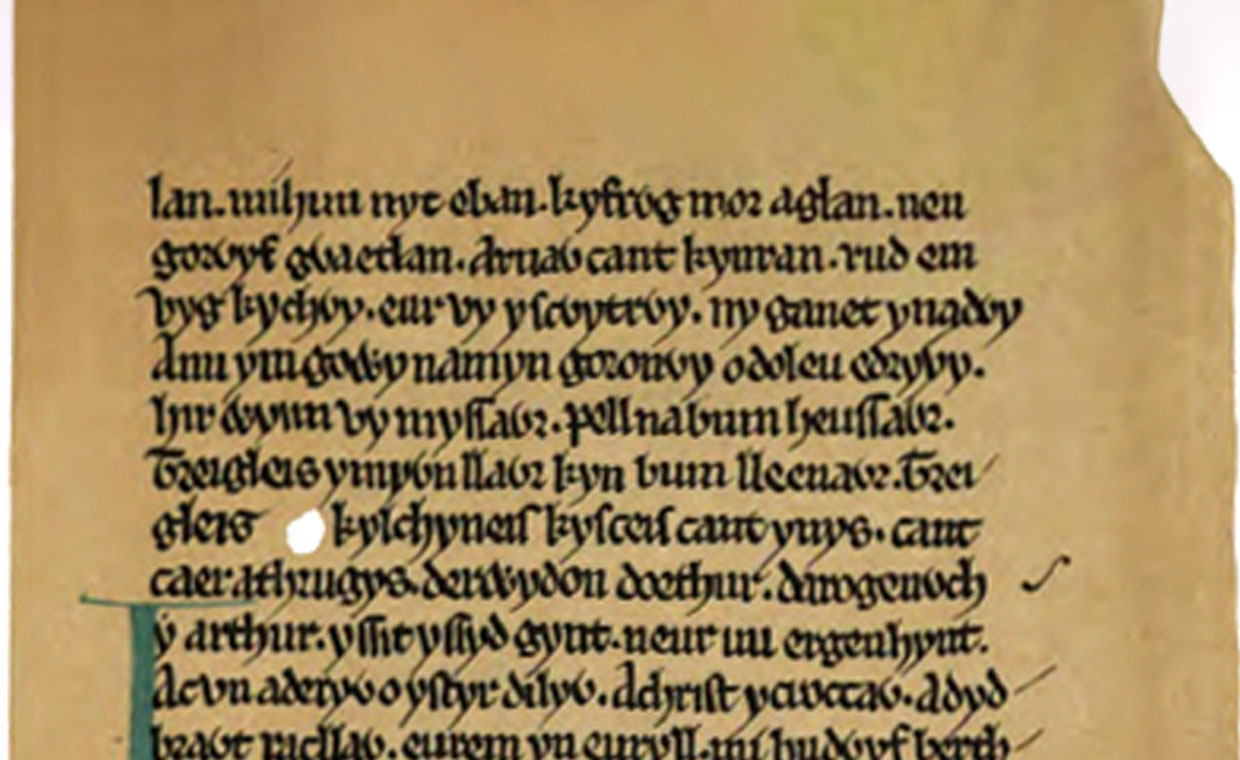
‘Another poem, “Gwaith Argoed Llwyfain”, refers to another campaign against the Angles of Bernicia. It also provides remarkable insights. Here, the leader of the Angles is named as Fflamddwyn – perhaps meaning “flamebearer” or “flamboyant one.” It may refer to Theodoric of Bernicia (r. ca. 584-591) whose reign coincides with Urien’s. The idea that it refers to Ida, the first king of Bernicia (r. 547-559), is probably too early to correspond to Urien and Owain’s dates (although there is some crossover with the earliest dates of Urien’s reign). The poem tells us:
“Saturday there was great conflict from the sun’s rising to when it went down. Fflamddwyn marched forward in four battalions to lay waste the lands of Goddeu [southern Scotland] and Rheged. From Argoed to Arfynydd [locations not identified but which may mean “forests” and “mountains” respectively] the muster was summoned.”
We can note the muster – perhaps like the calling of the fyrd in later Anglo-Saxon England although also similar to the calling up of men in earlier armies too. Fflamddwyn demanded hostages but was refused. Opposing Fflamddwyn were, not only Urien but also his son Owain, scourge of the Eastlands. Although the poem dwells on Urien’s speech of what he intends to do rather than recount what actually happened at the battle, it speaks to his defiance at the invasion of the Angles and of the interminable back and forth warfare between the kingdoms.’
Murray is an ancient and medieval military historian from New Zealand, living in Australia. He has written more than 100 articles on various aspects of ancient and medieval military history and other historical topics from all periods. He is the author of Macedonian Phalangite vs Persian Warrior, Athenian Hoplite vs Spartan Hoplite and Leuctra 371 BC, all from Osprey Publishing. He is a regular on the Ancient Warfare Podcast.