
Category: Military
-
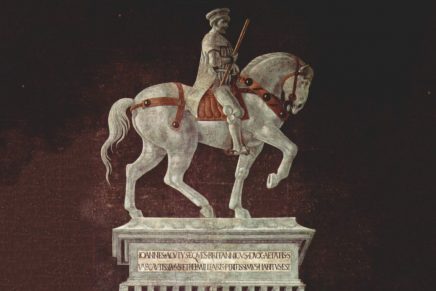
2809 – John Hawkwood, The Greatest Mercenary of His Age pt.2
By 1365 the English mercenary John Hawkwood had an army of 7,000 horses with 43 corporals under him serving cities in Italy. With this army his reputation grew and grew. With his new force Hawkwood turned his attention on Florence. The Florentines (as one of the richest cities in Italy) responded by paying off Hawkwood…
-
2808 -John Hawkwood, The Greatest Mercenary of His Age
The greatest mercenary commander of the 14th century, inspiration for historians, poets, novelists and playwrights, John Hawkwood is a name everyone should know. 14th century Europe was a plagued with incessant warfare. The Hundred Years’ War began between France and England in 1337 and would last until the middle of the next century. Other conflicts…
-
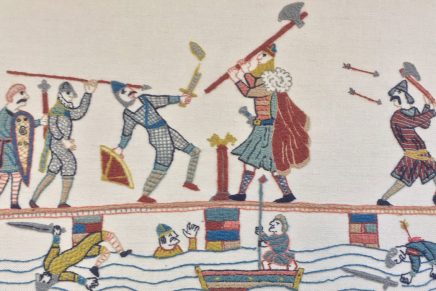
2807 – The Battle of Stamford Bridge
By the beginning of September 1066, King Harold II was in a quandary. Expecting Duke William of Normandy to invade, he had summoned the fyrd (what passed for the army in Anglo-Saxon times; made up of a proportion of the freemen of each shire who were required to perform military service in defence of the…
-
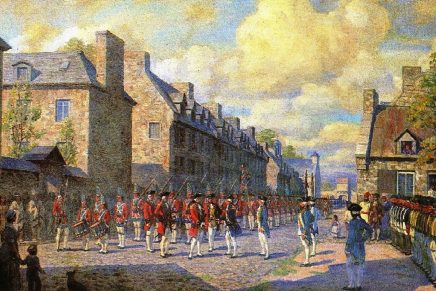
2806 – Lieutenant-General Sir Jeffrey Amherst and the Conquest of New France
The Seven Years War, fought from 1756 to 1763, pitted the alliance of France, Austria, Sweden, Saxony, Russia and Spain; against Great Britain, Prussia and Hanover. The first truly world war, campaigns in the war were fought in Europe, India, North America, and on the oceans throughout the world. In the North American theater of…
-

2805 – The ubiquity of the Cretan archer in ancient warfare pt. 2
One thing to note in regard to Cretans is that when they are mentioned in our sources they are always referred to as Cretan archers or just ‘Cretans’ or, occasionally just archers and we must work out from the context that they were Cretan. This episode was written by Murray Dahm, Murray Dahm is an…
-
2804 – The ubiquity of the Cretan archer in ancient warfare
When a contingent of archers is mentioned in the context of Greek and Roman armies, more often than not the culture associated with them is that of Crete. Indeed, when we just have archers mentioned in an army without a specified origin, Cretan archers are commonly assumed to be meant, so ubiquitous with archery and…
-

2803 – Bougainville: Civil War leads to new nation
Bougainville is a 9000 sq. km pacific island and was first subject to European contact in 1768 when Louis Antoine De Bougainville landed there and, in an act of typical vainglory, named it for himself. People had been on Bougainville for 28,000 years but it was the Austronesian people who 4,000 years ago established pigs, chickens,…
-
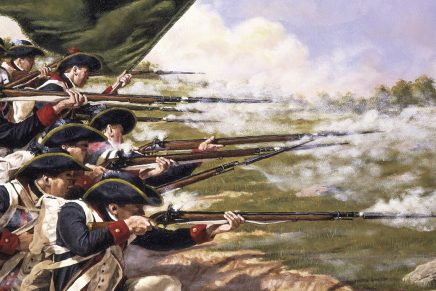
2801 – The Battle for New York, part 2
“Washington did not place his hopes on the negotiations as he focused on strengthening the defenses around New York. He even tried his hand at irregular warfare by ordering an attempt to destroy the British flagship, HMS Eagle, using the first documented case of submarine warfare. The ship, the Turtle¸ was to sail undetected under…
-
2801 – The Battle for New York
“By the end of 1776, the British had chased the decimated Continental Army out of New York and expected to crush the rebellion once and for all in the new year. What dramatically shifted the odds to Britain’s favor was a campaign that saw the Americans lose battle after battle and suffer thousands of casualties.…
-
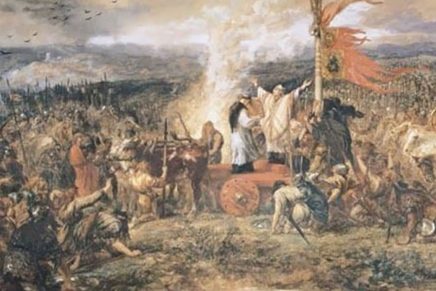
2710 The Battle of the Standard, 1138. pt2
‘At the moment when the Galwegians were at their most hard pressed, it seems as if Prince Henry led his Battle in a charge (the detail is not in Richard of Hexham). Henry ‘hurled himself, fierce as a lion, upon the opposing wing.’ He put the English to flight on that wing (the English left)…