
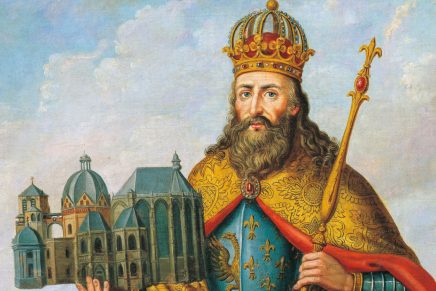
The machinery of war which Charlemagne inherited from his father. Pepin the Short, and grandfather (Charles Martel, ‘the hammer’) was singularly well tuned to wage war. All of Charlemagne’s vassals were expected to serve militarily and all free men were expected to serve if needed. This service included bishops, abbots and abbesses; they too could be called upon to provide armed men or other provisions of war according to the wealth of their estates. These men would be drawn together by a royal summons or bannum and if a mobilisation of all free men in a particular area was called for, it was known as the lantweri.
We can see in these procedures the beginnings of feudalism. Each ruler or governor of a particular area within the empire (usually someone who had sworn allegiance or was of known loyalty) had a personal retinue of trained and professional warriors and these could be called upon by the king. Failure to do so was punishable by hefty fine or even death.
This episode was written by Murray Dahm,
Murray is an ancient and medieval military historian from New Zealand, living in Australia. He has written more than 100 articles on various aspects of ancient and medieval military history, as well as other h storical topics from all periods (ranging from the history of opera to the runic alphabet and recipients of the Victoria Cross). He is the author of COMBAT 40: Macedonian Phalangite vs Persian Warrior: Alexander confronts the Achaemenids, 334-331 BC from Osprey publishing. He is a regular on the Ancient Warfare Podcast.
>>Download<<