
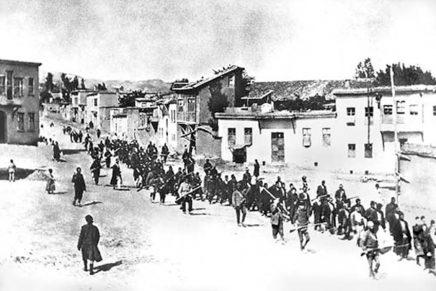
In his 1944 book ‘Axis Rule in Occupied Europe’, Raphaël Lemkin says that “genocide is composite and manifold, and that it signifies a coordinated plan of different actions aiming at the destruction of the essential foundations of life of a [specific] group.” Collective dispossession, including plunder and spoliation, is only one of the many crimes that accompany and even fortify genocidal policies—or perhaps better said, expropriation and pillaging are important aspects of the political economy of genocide. As Martin Dean, an authority on Nazi looting and plundering of Jewish property, remarkably underlines, “ethnic cleansing” and genocide usually have a “powerful materialist component: seizure of property, looting of the victims, and their economic displacement are intertwined with other motives for racial and interethnic violence and intensify their devastating effects.” In the case of the Armenian genocide, the state-orchestrated plunder of Armenian property immediately impoverished its victims; therefore, it was simultaneously a condition for and a consequence of the genocide.
This episode was written by Ümit Kurt.
Ümit Kurt is a historian of the Modern Middle East with a particular focus on the transformations of the imperial structures and their role in constituting the republican regime. Kurt is Polonsky Fellow at the Van Leer Jerusalem Institute. He is the author of several books in Turkish and English, including “The Spirit of the Laws: The Plunder of Wealth in the Armenian Genocide.” His recent book is, The Armenians of Aintab: The Economics of Genocide in an Ottoman Province, published by Harvard University Press, May 2021. He is currently teaching in the Dept. of Islamic and Middle Eastern Studies at the Hebrew University of Jerusalem. Kurt is the winner of the Discovery Early Career Research Award of 2021, given by the Australian Research Council.
>>Download<<