
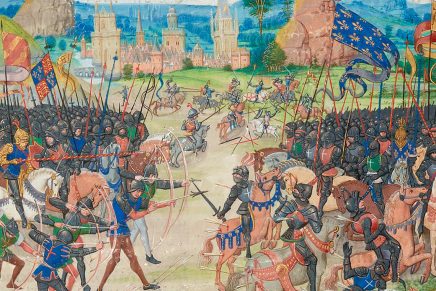
On the death of King Charles IV of France in 1328, Edward III of England was his closest male heir and therefore the legitimate successor to the throne of the childless Charles. This was due to the ancient Salian (or Salic) law which prevented female succession (it had, however, only been enacted in 1316). Despite Edward’s legitimate claim, the French crowned Philip, Count of Valois, King Philip VI of France and the slighted Edward refused to pay him homage. In revenge, Philip confiscated Edward’s lands in Aquitaine (held as a vassal Duchy to the crown of France). Edward, therefore, declared war against France and plunged England and France into a war that would last, on and off, for the next one hundred and sixteen years, a war we know as the Hundred Years War.
This episode was written by Murray Dahm.
Murray is an ancient and medieval military historian from New Zealand, living in Australia. He has written more than 100 articles on various aspects of ancient and medieval military history and other historical topics from all periods. He is the author of Macedonian Phalangite vs Persian Warrior, Athenian Hoplite vs Spartan Hoplite and Leuctra 371 BC all from Osprey publishing. He is a regular on the Ancient Warfare Podcast.
>>Download<<