
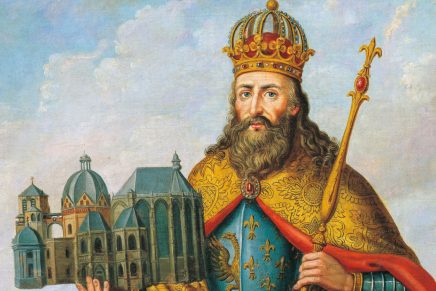
Charles the Great, known as Charlemagne and the father of Europe, created an empire which would last 1,000 years. To secure it he fought continuously, on multiple fronts, throughout his long reign.
Charlemagne came to power at a time when Europe was made up of many small kingdoms and principalities. Since the fall of the Roman Empire in the 5th century, it had also faced invasion from various peoples who had established kingdoms of their own, such as the Visigoths and Muslims in Spain. There were also new peoples on the outskirts of Europe who were either asserting themselves for the first time, such as the Danes and Norse, or intent on breaking into Europe itself such as the Avars. Europe also clung to the past and saw itself as a continuation of the Western Roman Empire. Throughout his reign (768-814), Charlemagne, his sons and commanders fought almost continuous wars of expansion and aggression. By the end of his reign he had created an empire which bore his name (Carolingian) which reached from Spain to the Balkans, Italy to the Baltic.
This episode was written by Murray Dahm,
Murray is an ancient and medieval military historian from New Zealand, living in Australia. He has written more than 100 articles on various aspects of ancient and medieval military history, as well as other h storical topics from all periods (ranging from the history of opera to the runic alphabet and recipients of the Victoria Cross). He is the author of COMBAT 40: Macedonian Phalangite vs Persian Warrior: Alexander confronts the Achaemenids, 334-331 BC from Osprey publishing. He is a regular on the Ancient Warfare Podcast.
>>Download<<