
Category: Military
-
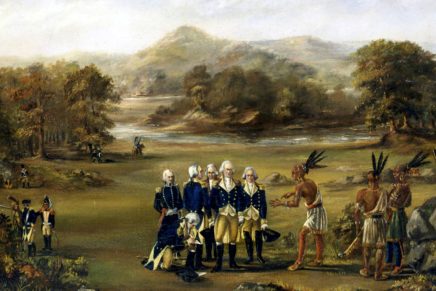
3206 – The Northwest Indian War (part 1)
“At dawn they came. Howling their war chants that cut through in the early morning mists. In the camp, men readied their weapons in preparation of the horrors that awaited them. The unseen enemy had already killed several of their company in small, fast strikes when the invaders had searched for food and fodder. Now…
-

3205 – Saladin
On 4 July 1187, the Sultan of Egypt and Syria, An-Nasir Yusuf Salah ad-Din ibn Ayyub—better known to us as Saladin—won a tremendous victory, one of the most famous of the Middle Ages. Beneath the Horns of Hattin, the twin peaks of an extinct volcano, his forces destroyed the largest army that the Crusader states…
-
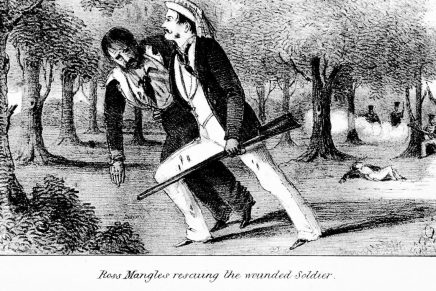
3204 – Ross Lewis Mangles and William Fraser McDonell at the Siege of Arrah
We saw in episodes 3104 and 3007 that due to the remarkable actions of several civilians who took up arms under military orders during the Indian Mutiny in 1857 and 1858 that the newly instituted Victoria Cross was altered to allow such acts of bravery to be recognised. Although Thomas Henry Kavanagh was recognised as…
-
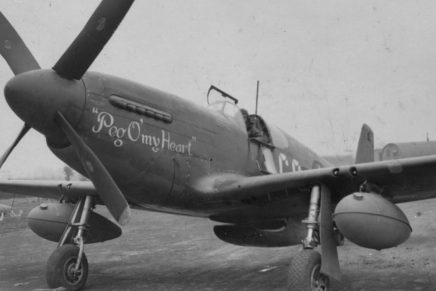
P-51 Mustang
In 1940 the British Purchasing Commission approached North American Aviation (NAA) to build under license Curtis P-40 fighters. NAA suggested that rather than produce an old design they proposed a new design, this would become the P-51 Mustang. When fitted with the Roll-Royce Merlin engine, the Mustang would be one of the most important fighters…
-
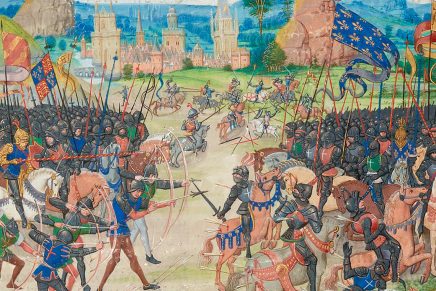
3203 – The Battle of Poitiers
On the death of King Charles IV of France in 1328, Edward III of England was his closest male heir and therefore the legitimate successor to the throne of the childless Charles. This was due to the ancient Salian (or Salic) law which prevented female succession (it had, however, only been enacted in 1316). Despite…
-
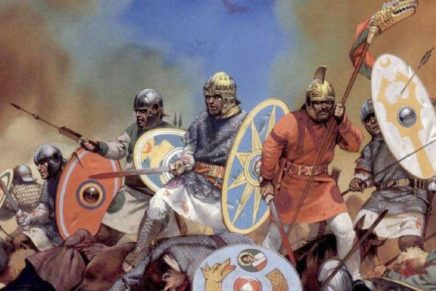
3202 – The Gothic Genius of Fritigern – Part 2
In the year AD 378, the Eastern Roman Emperor Valens left Antioch to return via Constantinople to deal with the Gothic threat which had been ravaging Thrace and the surrounding provinces since 376. He also sought help from his nephew and the Western Roman Emperor, Gratian. Gratian was prevented from coming quickly to Valens’ aid…
-
3201 – The Gothic Genius of Fritigern – Part 1
The Gothic leader Fritigern (possibly based on the Gothic Frithugairns) is, perhaps, one of the most under-appreciated commanders in the ancient world. At the head of a complex confederation of Gothic tribes, he imposed a devastating defeat on the forces of the Western Roman empire at the battle of Adrianople (or Hadrianople) on August 9th,…
-
AW186 – The Biggest Recent Developments in Ancient Warfare
We regularly receive emails for Jasper and Murray with suggestions for Ancient Warfare Answers. Greg asked ‘what have been the biggest developments or changes in the past 15-20 years in our understanding of ancient warfare?’ It is too good of a question for just Murray and Jasper, so in this episode of the Ancient Warfare…
-
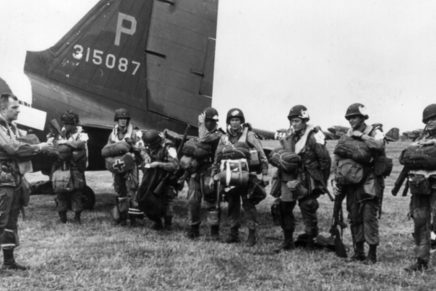
3110 – The American Airborne Landings during D-Day
??The Allied landings at Normandy on June 6, 1944 were the largest amphibious operation ever undertaken in military history. Across five separate beaches, over 150,000 men made up the landing forces from the United States, United Kingdom, and Canada. To protect the men on the beaches, a massive bombardment of naval gunfire and aerial bombs…
-
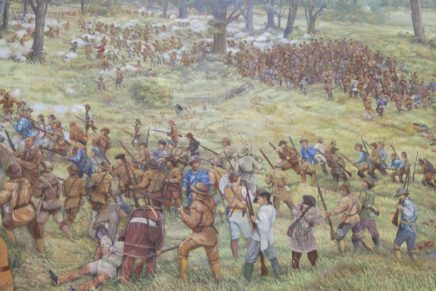
3109 – Lord Dunmore’s War
‘At the end of the Seven Years War, the Proclamation of 1763 was issued by the British, which granted any lands west of the Appalachian Mountains in the Ohio Valley of North America to the Native Americans. American colonists could not settle any of these lands and would be forcibly removed by British forces if…